
What Is Bodo Culture? A Beginner's Introduction
If you've discovered ShiZwm for the first time, you may have come across something unfamiliar.
A word.
A pattern.
A design.
A reference to Northeast India.
And perhaps you've wondered:
What is Bodo culture?
This article is a simple introduction.
Not a complete history.
Not an attempt to define an entire community in one article.
Just an invitation to discover a little more about the culture that inspires our brand.
Who Are the Bodo?
The Bodo are an Indigenous community of Northeast India, with a strong cultural presence in Assam and particularly in the Bodoland region.
The community has its own language, traditions, festivals, clothing, music, dance, crafts and cultural practices.
Like every living culture, Bodo culture isn't frozen in time.
It continues to evolve.
Modern life, younger generations, technology, education and contemporary creativity all become part of how culture is experienced today.
Clothing as Cultural Expression
Clothing has an important place in cultural expression.
Traditional garments, textiles, patterns and weaving practices can communicate identity while also reflecting craftsmanship and creativity.
Two names you may encounter when exploring Bodo clothing are Dokhona and Aronai.
Dokhona is traditionally associated with women's attire, while Aronai is a traditional woven textile with cultural and practical significance.
For ShiZwm, these elements are particularly interesting because they show how something functional — something made to be worn — can also carry identity and visual language.
Aronai
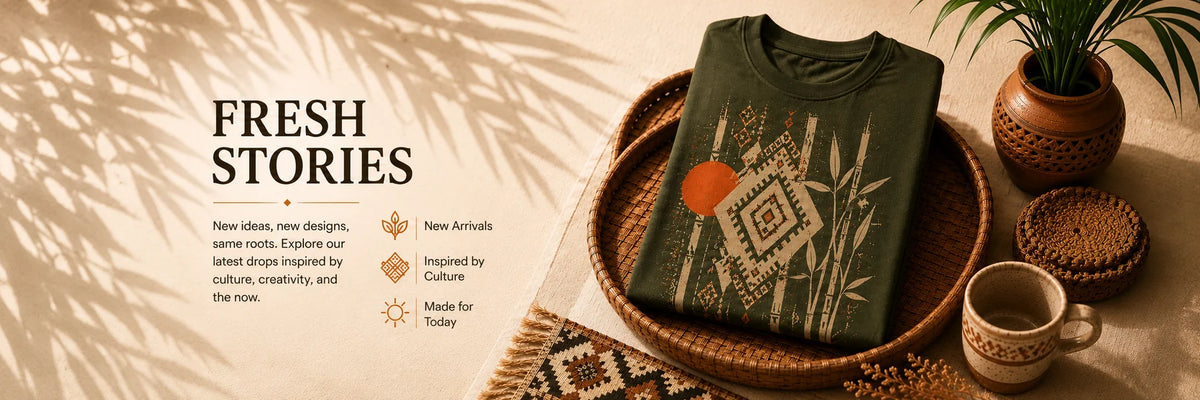
If you have seen ShiZwm's designs, you may notice references inspired by traditional patterns.
Aronai is particularly meaningful within Bodo cultural expression and has become one of the visual elements we are interested in exploring.
Rather than treating traditional design as something that belongs only in the past, we see it as a source of inspiration for contemporary creativity.
From Tradition to Contemporary Design
A pattern can be studied.
Reinterpreted.
Simplified.
Reimagined.
And eventually transformed into something new.
Festivals and Community
Culture is not only found in clothing.
It lives in celebrations, music, dance, food, language, family and community.
Bwisagu, for example, is an important festival associated with the Bodo community and is connected with the arrival of the spring season and the beginning of the Bodo New Year.
Music and dance also form an important part of cultural expression, including the well-known Bagurumba dance tradition.
These aren't simply subjects for us to put on a T-shirt.
They are part of the wider world that helps shape our creative perspective.
Nature and Everyday Life
The Northeast is also known for its rich natural landscapes.
For us, nature is another source of inspiration.
Forests.
Rivers.
Hills.
Wildlife.
Plants.
The changing colours of the seasons.
Sometimes inspiration doesn't come from a historical symbol at all.
It comes from something you see every day.
That's one reason we believe culture and contemporary design can coexist naturally.
A Culture Is More Than Its Symbols
It's easy to look at a pattern, garment or festival and think that you've understood a culture.
But culture is much deeper than its visible elements.
Culture Lives in Everyday Life
It lives in language.
In relationships.
In memories.
In stories passed between generations.
In things people do every day.
And it continues to change.
That is why our approach at ShiZwm is one of curiosity and respect.
We are still learning.
And through our Journal, we hope to share what inspires us while encouraging people to discover more for themselves.
From Our Home to Yours
If you are completely new to Bodo culture, we hope this article gives you a starting point.
Maybe your first discovery will be a word.
Maybe it will be a pattern.
Maybe a piece of music.
Maybe a ShiZwm design.
Whatever brings you here, we hope you leave knowing something you didn't know before.
Because that's what stories can do.
They can make unfamiliar places feel a little closer.
This is one of the stories behind ShiZwm.
And we're only getting started.